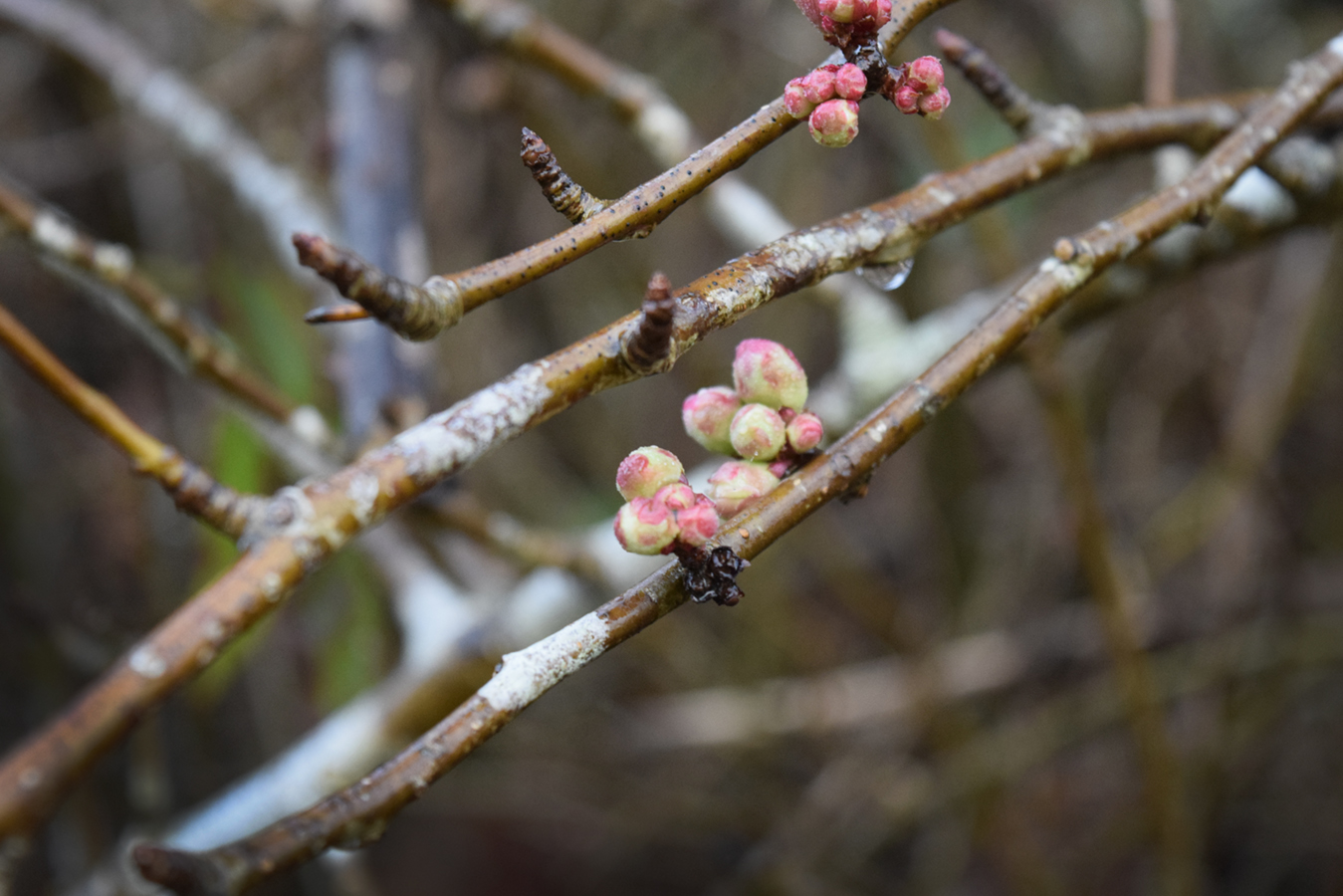
Today, I spotted the first buds of the flowering quince shrub just starting to emerge. I suppose it hasn’t been so cold this winter to keep that from happening, but I was surprised to find them nonetheless. This particular shrub is a volunteer, though I think it might have originated from some plantings that my grandmother had done for a lath-house that used to stand where the quince is now.
Flowering Quince, or Chaenomeles, is a genus of three species of deciduous spiny shrubs, usually 1–3 m tall, in the family Rosaceae. They are native to Japan, Korea, China, Bhutan, and Burma. (Burmese: ချဉ်စော်ကား) These plants are related to the quince (Cydonia oblonga) and the Chinese quince (Pseudocydonia sinensis), differing in the serrated leaves that lack fuzz, and in the flowers, borne in clusters, having deciduous sepals and styles that are connate at the base.
The leaves are alternately arranged, simple, and have a serrated margin. The flowers are 3–4.5 cm diameter, with five petals, and are usually bright orange-red, but can be white or pink; flowering is in late winter or early spring. The fruit is a pome with five carpels; it ripens in late autumn.
Chaenomeles is used as a food plant by the larvae of some Lepidoptera species including the brown-tail and the leaf-miner Bucculatrix pomifoliella. (From a page at Wikipedia – https://en.wikipedia.org/wiki/Chaenomeles).
The canes and flowers are often a favorite with floral designers, as they hold their form and lend as a bright, sturdy backdrop for other things, or are lovely by themselves. Butterflies love this shrub.
When I lived in California, I had a job working as a landscape assistant to a fellow who had been trained in his craft by a Japanese gardener. Much of his aesthetic around gardening and gardening maintenance reflected that sensibility and I learned much from him (to add to earlier knowledge gleaned from my parents and grandparents).
I suppose that that was the time I first became aware of bougainvilleas, as we tended several large patches of them at one of the old estates (pre-1991 Oakland Hills fire). They looked so much like the flowering quince that has been here on my family’s property, from the time that I was quite little, that I nearly felt like I was back at home. My first, goofy meeting with the bougainvilleas was to wade right in with the purpose of thinning and collecting some canes. Much to my surprise, these ‘quince’ had quite the monstrous thorns. They chewed up my lower arms and pricked my hands to a fare thee well before I could favorably extract myself.
It was when I told my wife (at the time) about the incident, about having waded into a thicket of quince, to be mauled instead by bougainvilleas, that I learned another interesting fact about quince. When she asked me to repeat what I thought I’d been dealing with she said, “Quince. Quince? Spell it.” So, I did. “Oh!” she remarked. “You mean queens!” I told her I had no idea what she was talking about. “Queens,” she rejoined me. “That’s how I learned to call them from my Portugese Vovó (grandmother).”
 My Little Firmament
I really enjoyed this article, and how you describe the beauty of “Queens.” I learned a lot about this particular plant and love that they attract butterflies!
LikeLike
Thank you. The honey bees like this flower too, and one year when I thought their population locally had dwindled due to the Varroa mite (http://pubs.cahnrs.wsu.edu/impact-reports/honey-bee-health/), I happily discovered many buzzing around the flowering quince (‘queens’). Last spring there were a number of monarch-type butterflies here too, though I didn’t pay attention to which plants they were visiting.
LikeLike
Thank you. The honey bees like this flower too, and one year when I thought their population locally had dwindled due to the Varroa mite (http://pubs.cahnrs.wsu.edu/impact-reports/honey-bee-health/), I happily discovered many buzzing around the flowering quince (‘queens’). Last spring there were a number of monarch-type butterflies here too, though I didn’t pay attention to which plants they were visiting.
LikeLike
I saw many beautiful bougainvillea when visiting my parents home in northern Australia. Their beautiful flowers filled the fence line along one side of their property. They are a very common plant in that area and I remember the thorns. I have never seen a quince shrub but friends have a quince tree that produces the pear-like fruit. Growing up in New Zealand, I recall my mother making a jelly from quinces and apples combined. I enjoyed that taste on my morning toast.
LikeLike
I understand that there is a quince tree that is a kind of fruit in, as you said, New Zealand. I think they’re also found in Australia, though I haven’t researched this, as my experience and simple knowledge only covers the more or less native ornamental, the Flowering Quince. It forms a veritable thicket, impenetrable, but the deer love to nibble on the leaves and flowers. As such, they sort of keep it thinned down. I don’t really do much to groom the thicket, letting it go wherever it wants.
LikeLike